




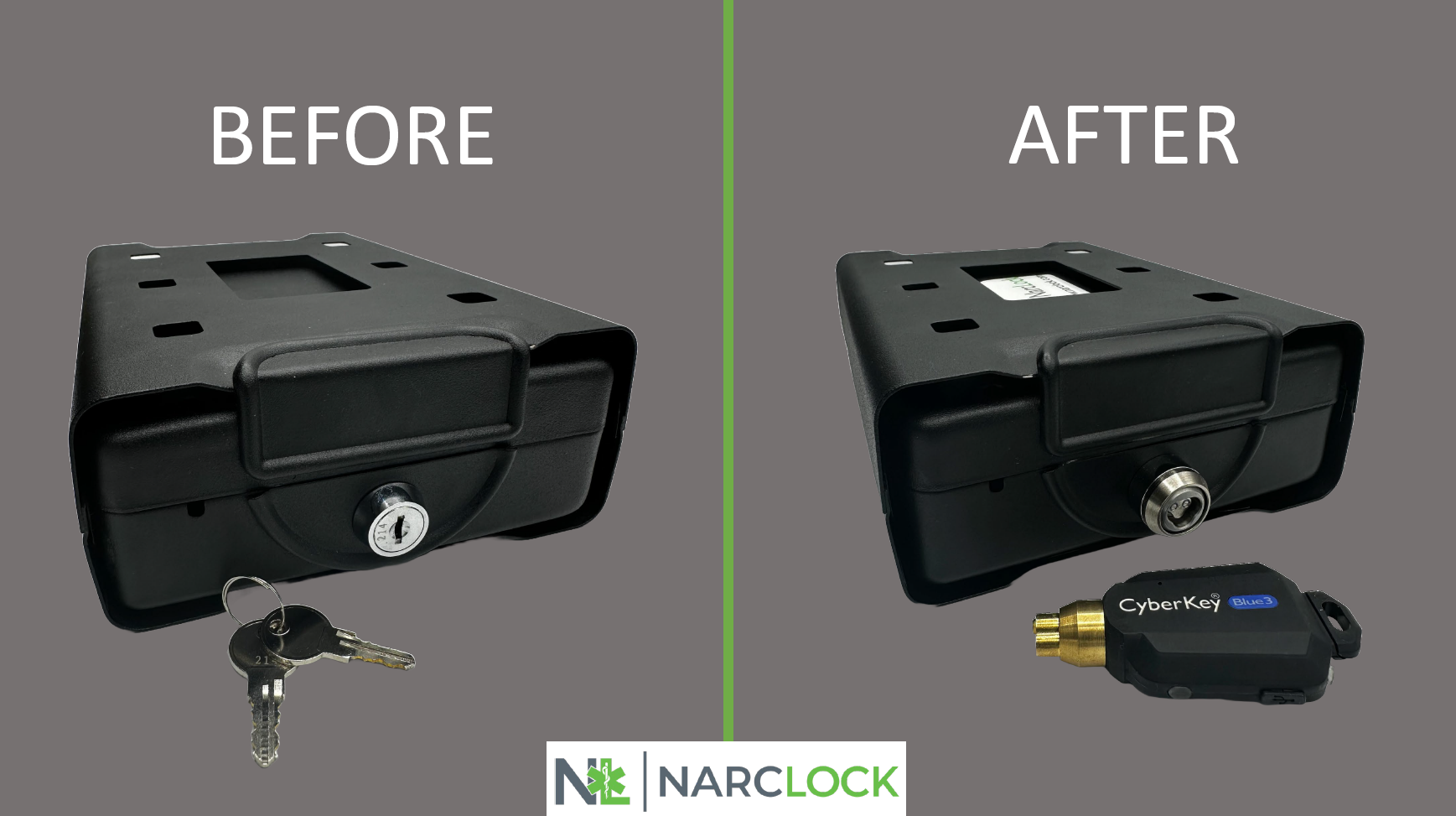
Do you have safes today that you would prefer to keep vs buying a whole new solution? NarcLock doesn’t force you to buy new safes. Instead, we add access control to your current safes today without the need for wiring or powering.
An EMS narcotic tracking system must prove who opened the box, when it happened, and whether the attempt was allowed. The hardware should survive vibration and weather. The logs should hold up during regulator reviews.
What an EMS narcotic tracking system must do
Direct answer: Issue per‑user credentials, restrict access by role and shift, log every open and attempt, work offline, and export reports on schedule.
- Per‑key identity for each paramedic, EMT, and supervisor
- Time windows tied to shifts and stations
- On‑lock and on‑key event memory for failed and successful attempts
- Offline first; sync when back at the bay
- CSV/PDF exports for audits
Critical insight: Identity belongs in the key, not in a shared code.
Federal rules that shape EMS storage and reporting
Direct answer: Store controlled substances in a securely locked, substantially constructed container and keep effective controls against diversion. If you discover a theft or significant loss, notify DEA within one business day and file DEA Form 106 within the required timeframe.
- 21 CFR §1301.75 — storage in a securely locked, substantially constructed cabinet
- 21 CFR §1301.76 — notify DEA within one business day and submit Form 106 within 45 days
- DEA Practitioner’s Manual (2023)
Field deployment steps
Direct answer: Start with high‑risk assets, install cylinders, assign keys by role, set shift windows, and automate reports.
- Map assets: kits, cabinets, safe compartments, and vehicle boxes.
- Retrofit: drop‑in electronic cylinders on the identified doors and boxes.
- Assign keys: paramedic, EMT, supervisor; define station/shift windows. (Keys can be shared to help with costs. Talk to our team.)
- Revoke fast: disable a lost key; issue a replacement the same day.
- Report: export weekly exceptions and monthly audit summaries.
Code box vs. electronic cylinder
| Scenario | Code box | Electronic cylinder |
|---|---|---|
| Shift turnover | Codes linger for days | Keys expire at shift end |
| Lost credential | Change codes fleet‑wide | Disable one key |
| Identity | Shared number | Per‑user key ID |
| Audit export | Manual | One‑click CSV/PDF |
| Power dependency | Often tied to vehicle power | The key energizes the cylinder |
Policy alignment – medication security and privacy
Direct answer: Align storage and access with accreditation and privacy expectations. Keep logs secure when they include patient identifiers.
Critical insight: Hardware, policy, and logs must match word‑for‑word.
Numbers you can cite
- On‑lock memory: ~1,500 events; on‑key memory: ~3,000 events.
- One key can open many locks with permissions by role and time.
- No new wiring for cylinder retrofits.
Confirm federal and state rules
Before/After — crew workflow
Before: shared codes, paper logs, and end‑of‑shift reconciliations that miss attempts.
After: individual keys, automatic event capture, and scheduled exception reports.
Head over to our contact page and fill out the form if you’re interested in learning how NarcLock can help your EMS fleet.